Why enterprise AI agents fail in production and what it takes to build them right
A recent discussion in the Future Intelligence Think Tank on LinkedIn raised a question that keeps surfacing across enterprise AI teams: at what point does an AI agent stop being a useful tool and start becoming a liability?
The answers pointed in the same direction. The problem is rarely the model. It's everything built around it, or more often, everything that wasn't built around it before deployment.
A model produces output. An agent starts a process
Most enterprise AI conversations still center on the same question: which model should we use? For traditional AI systems, that's at least half the answer. For AI agents, it's closer to a starting point.
An AI agent can reason through a task, decide what steps to take, call tools and APIs, retrieve information from multiple sources, and trigger actions across a workflow. Evaluating a model means assessing the quality of its responses. Evaluating an agent means looking at the quality of an entire workflow, end to end, across every step it took to reach that point.
Why production is harder than a demo
In a proof-of-concept, the conditions are favorable by design. The request is clear, the tools work, and the APIs respond correctly. The agent appears capable because the environment was built to make it look that way.
Production is a different story. Requests are ambiguous, data is scattered across systems that don't communicate cleanly, and a permission rule may block part of the process before the workflow can even continue. A permission rule may block part of the process mid-way. Unlike a model that risks giving a weak answer, an agent can take a wrong step and propagate that error across everything that follows.
The failure surface isn't a single output; it's a chain of decisions, each one dependent on the one before it.

What a production-ready agent requires
Choosing the right model is necessary, but insufficient. The more important questions for enterprise agentic AI are architectural. Can the agent recognize the boundaries of the workflow it's operating in? Can it decide when not to act? Can it escalate to a human when confidence is low? Can every action it takes be logged, audited, and reversed if needed?
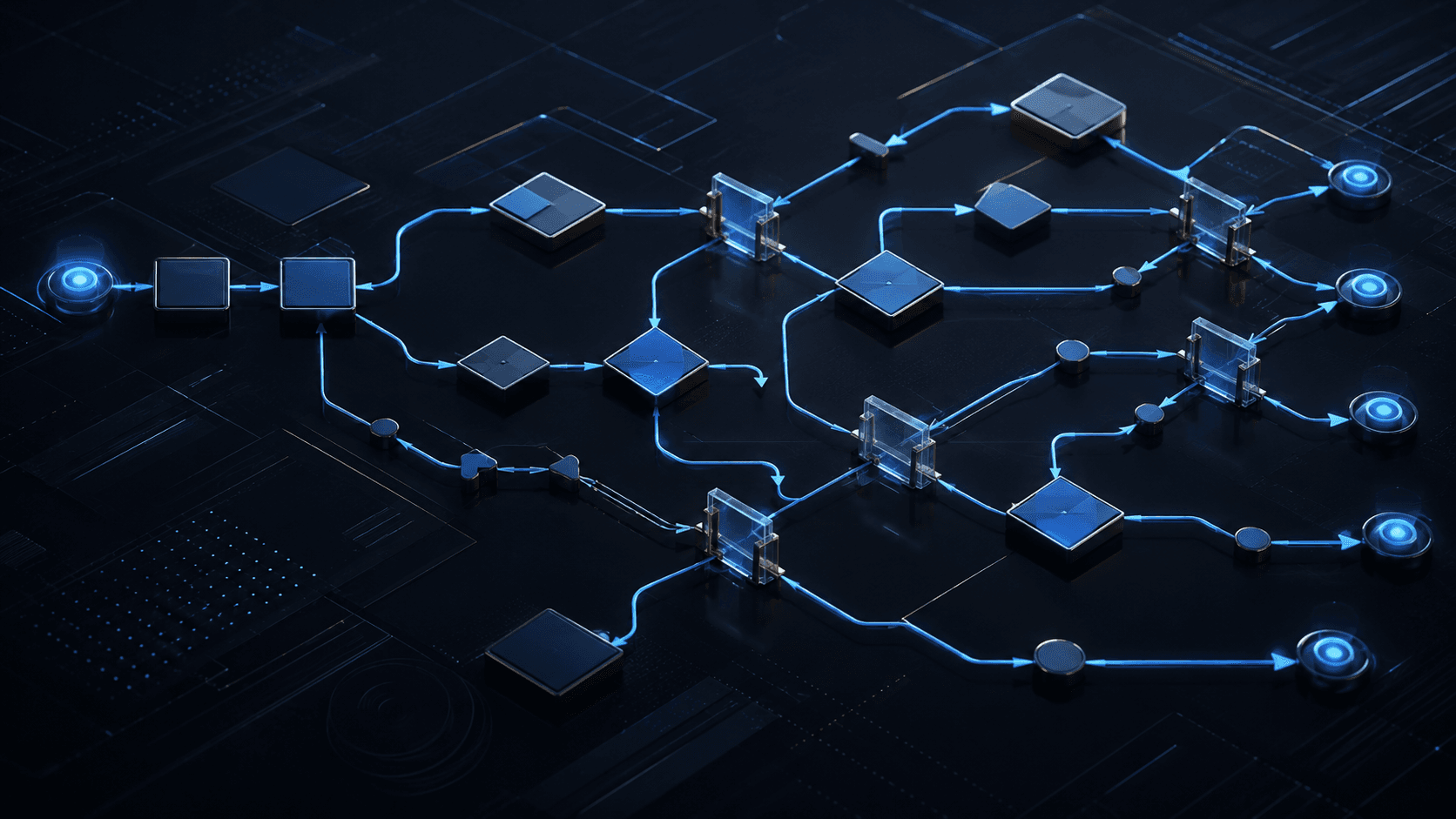
A production-ready AI agent needs orchestration, observability, permission management, fallback logic, and clearly defined human-in-the-loop checkpoints. Without these layers, even a highly capable model becomes unreliable inside a real enterprise workflow.
Agents create chains of risk that traditional AI doesn't
Traditional AI systems have a relatively contained failure surface. Agents expand it significantly, operating across multiple steps, often interacting with several systems in sequence. A misunderstood instruction at step one doesn't stay there.
In many enterprise contexts, the most reliable architecture is a hybrid one: deterministic logic for predictable steps, AI reasoning for flexible interpretation, and human approval for decisions that carry real risk. The goal isn't maximum autonomy, it's a more effective workflow that stays reliable, traceable, and safe.
Observability isn't optional, it's a business requirement
With traditional AI, monitoring focuses on uptime, latency, and error rates. With agents, that's not enough. Enterprises need to understand not just whether the system ran, but how it behaved. Which tools did it use? Where did it hesitate? When did it escalate, and why? Did it produce the right business outcome, or just a technically valid output?
In domains where reliability, compliance, and accountability are non-negotiable, such as healthcare, defense, finance, and industrial automation, an agent cannot operate as a black box. It must operate within defined boundaries, and those boundaries must be auditable.
How ASSIST Software approaches this
At ASSIST Software, we treat AI agents as engineered software with reasoning capabilities, with the same seriousness applied to any mission-critical architecture. That means designing workflows with fallbacks and approval gates from the start, testing against edge cases rather than ideal paths, and measuring success by business outcomes rather than demo performance.
AI agents can create significant value. But that value depends entirely on how they are built and governed, not on the intelligence of the underlying model alone.
The next stage of enterprise AI will be defined by who builds agents that work reliably under real operational constraints, not by who builds the most impressive proof-of-concept. The engineering discipline is what separates demos from deployed systems.